| Music | Literature | Film | Index | About |

 |
 |
|
|
|
||||
|
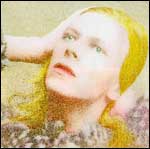
Hunky Dory, David Bowie RCA Records, April, 1971 Track Listing: 1. Changes, 2. Oh! You Pretty Things, 3. Eight Line Poem, 4. Life on Mars?, 5. Kooks, 6. Quicksand, 7. Fill Your Heart, 8. Andy Warhol, 9. Song for Bob Dylan, 10. Queen Bitch, 11. The Bewlay Brothers
David Bowie grew up in the suburbs too so perhaps it is not all that surprising that Hunky Dory is a Ziggy-Stardust-spaceship ride millions of miles away from Vanilla Street. Somehow, those ditches dug well beyond the outskirts of the city just couldn’t contain us all. Some just longed for a life a tad more glamorous, honey. Some of us needed sequins, baby! “No room for me, no fun for you -from “Oh! You Pretty Things” It started with a tickle that needed scratching. That was the beginning of an awareness that something (perhaps, me and you) didn’t belong on the conveyer belt. Such is the dreamer’s dream, to hold in their lovely manicured fingers a one-way ticket to a destination unknown. “Now she walks through her sunken dream -from “Life on Mars?” It didn’t matter where. Anywhere but here. Music offered an invitation to a party where hoboes and homos were at the front of the line. It was a place where you could be anyone you wanted to be. It’s Warhol actually. -David Bowie Like punk, glam rock provided an alternative when alternatives didn’t seem to exist. It wasn’t a gimmick, it was a vehicle and Bowie was driving the ship, abducting kids from every last corner of the galaxy, welcoming them with open arms. His own escape from suburban drudgery made him the de facto leader, not that there weren’t others: Eno, Ferry, Alice Cooper, Marc Bolan, Lou Reed, Iggy Pop, The New York Dolls. The party list grew and even included artists hidden from the mainstream, like Klaus Nomi, a resident alien hidden in the catacombs of New York’s underground scene. It was Bowie himself who would shine a spotlight on Nomi, asking him to be a backup singer during Bowie’s appearance on SNL, December 14, 1979. Maybe, he did this out of respect for the fact Nomi probably inspired Bowie to give birth to a new other-wordly persona of his own. “She’s so swishy in her satin and tat -from “Queen Bitch” In a scene that thrived on diversity, Bowie still managed to separate himself from the pack. He was the head alien. He was the king. And the queen. To pay homage, I highlight Hunky Dory as my favorite Bowie release, even if my words are nothing more than a faint cry from an outpost hidden somewhere on this strange planet Earth.
|
 |
||||||
 PRINT
PRINT
 TWITTER
 FACEBOOK
 EMAIL
EMAIL MORE
MORE