| Music | Literature | Film | Index | About |

 |
 |
|
|
|
||||
|
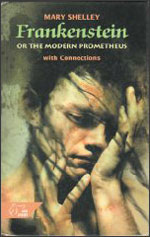
Frankenstein, Or, The Modern Prometheus, Mary Shelley Lackington, Hughes, Harding, Mavor & Jones, January 1, 1818
A car carrying two teenagers stalls on a bridge in the woods. The engine rolls over a few times before sputtering out completely, leaving crickets and other critters front and center in the wilderness symphony. Bugs buzz by excitedly in their haste to gain access to the light of two laser beams shooting out from the stalled car’s headlights. The illumination exposes the boundaries of a dirt trail that is swallowed by a mass of foreboding forest trees off in the distance. Calls of “Whooo? Whooo?” ring out from the darkness. It is a night owl. Mixed in is the quivering voice of a teenage boy. He is desperate to sound calm in front of his sweetheart but of course comes across as anything but. To our pained dismay, the boy commands his wide-eyed companion, “Llllllock the doors, keep the … keep the … keep the windows shut and hi … hide down low until I get back.” Huh? “Whatever you do, don’t unlock the door until you hear three knocks … llllllllike this. . . .” The ensuing tap … tap … tap manages to stir a fresh batch of terror from its methodically creepy cadence alone. And then, the boy is gone, scurrying across the bridge before disappearing into the black. How do we know this is not going to end well? Eyes dart around the fiery circle, eclipsing one frightened expression to the next. Although the campsite dwellers are all as still as the night—too afraid to move—their shadows possess lives of their own, dancing over the trees, jiggling to and fro in psychedelic waves of burning fear. It is the witching hour, a time for ghost stories, a time of monsters. Detour to an admission—one I suppose is not all that surprising nor leaves me in any sort of minority. That is, my exposure to one legendary monster mash did not first come from the source itself (i.e., the Mary Shelley novel). Nor did it come from a campfire tale for that matter. I made my way to Frankenstein via the Hollywood Boris Karloff route. When I did finally sit down with the Shelley novel so many years later, I was struck by how little I really knew of the story; for instance, the depth of emotion. I will never forget riding home on a CTA bus and being overcome by Shelley’s depiction of the absolute grief brought on by the death of a loved one. I fidgeted awkwardly in the bus seat. How odd it is to be amongst strangers as you are overcome by words on a page. I need not describe the feelings of those whose dearest ties are rent by that most irreparable evil, the void that presents itself to the soul, and the despair that is exhibited on the countenance. It is so long before the mind can persuade itself that she whom we saw every day and whose very existence appeared a part of our own can have departed forever—that the brightness of a beloved eye can have been extinguished and the sound of a voice so familiar and dear to the ear can be hushed, never more to be heard. These are the reflections of the first days; but when the lapse of time proves the reality of the evil, then the actual bitterness of grief commences. Yet from whom has not that rude hand rent away some dear connection? And why should I describe a sorrow which all have felt, and must feel? The time at length arrives when grief is rather an indulgence than a necessity; and the smile that plays upon the lips, although it may be deemed a sacrilege, is not banished. My mother was dead, but we had still duties which we ought to perform; we must continue our course with the rest and learn to think ourselves fortunate whilst one remains whom the spoiler has not seized. The Boris Karloff monster (whose name I somehow confused as “Frankenstein” until reading the Shelley novel) was a large, bolts-in-the-head creature lacking much depth beyond a pale complexion and an affinity for evil. Exposure to his human elements and conversely, to the rather stained characteristics of his creator, Dr. Victor Frankenstein, didn’t make their way into my translation. Perhaps I was too young to see beyond my idea of what a monster was: The Creature from the Black Lagoon, Dracula, The Werewolf, on through modern day with Michael Myers, Leatherface, Freddie, and all the rest. As it turned out, these misconceptions served me well for they ingrained in me a bias to the legendary Shelley monster that, as a result, helped lay a trap. I found myself relating to so many characters in the novel and I immediately viewed the monster as an abomination. This is why I picked up the novel in the first place. I was looking for an October read that might conjure up a fright fitting the calendar. But as I read the novel, I was taken aback by the monster’s depth of compassion and it helped me gain real perspective into his motives and tortured soul. I wonder if these positive qualities would have resonated so deeply for me had I not brought such bias to the story. Had I never been that child frightened by the film, would I have felt any empathy at all for Shelley’s (and Victor’s) creation or would I view the reasons behind the monster’s transition into evil as inexcusable at all costs? It’s funny. I like to pride myself on not being judgmental to differences in others. I like to think that I celebrate diversity across the board. But in the end, I wonder just how clean my record is. I suppose it is akin to the battle of good versus evil that rages on inside of us all. It is so easy to get lost along the way. Whether it is due to falling into a black hole of grief after the loss of a loved one, the passion and addiction of any obsessive quest, or any other of the traps that lay before us, it is startling to realize just how easy it is for any of us to turn into the monsters that we are so quick to condemn.
|
 |
||||||
 PRINT
PRINT
 TWITTER
 FACEBOOK
 EMAIL
EMAIL MORE
MORE