|
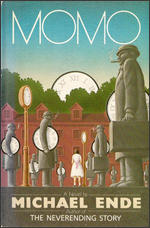
Momo, Michael Ende
Thienemann Verlag , January 1, 1973 (Germany),
Translated by J. Maxwell Brownjohn in 1984
I’m not sure how it happened. At the park, a Boston Terrier is panting uncontrollably after just two Frisbee fetches. Overnight, my relentlessly energetic, mischievous puppy somehow managed to turn into a slowing senior dog and I seemed to have missed it all. I guess I was too busy sneaking across my own unlikely middle age threshold.
Calendars and clocks exist to measure time, but that signifies little because we all know that an hour can seem an eternity or pass in a flash, according to how we spend it.
Yes, I am currently obsessing over the concept of time although I use the term “currently” loosely because it is a word hardly capable of living up to its own feeble definition. What can possibly ever be current? Like a dog chasing his tail, the present circles the past in a mind-numbing loop. The past prevails. It is here, somewhere along the murky banks of yesterday that I choose to begin my journey into the abyss of lost time, albeit not before admitting that any such voyage would surely be better captained by a Marcel Proust, or perhaps currently, Jennifer Egan.
Time is life itself, and life resides in the human heart.
I cannot pretend that Michael Ende’s definition of time here (as translated by Maxwell Brownjohn in Momo) doesn’t leave me slightly confused. Sure, I can offer up a guess, but since I seek definitive answers I revisit my previous instinct to defer to experts. Proust is no longer available and I don’t have a line to Egan so I turn to Ende’s mysterious and villainous men in gray for clarification. After all:
They were experts on time just as leeches are experts on blood, and they acted accordingly.
Never at a loss for words, the men in gray tirelessly pontificate, but what they say last stops me dead in my tracks.
“All that matters in life,” the man in gray went on, “is to climb the ladder of success, amount to something, own things.”
The end game is to own more things? The goal of getting a better job or better title is simply to make more money so you could own more things? A vacant mantra to be sure. Just who were these men in gray anyway with their endless babble, cigar smokescreens, and sneaky brainwashing techniques? And why were they so hell-bent on getting us all to save time anyway?
People never seemed to notice that, by saving time, they were losing something else. No one cared to admit that life was becoming ever poorer, bleaker, and more monotonous.
The men in gray asserted that time was a commodity.
“The Timesaving Bank not only takes care of the time you save, it pays you interest on it as well. In other words, you wind up with more than you put in.”
For a children’s book, Momo sure does cut deep with its time-sucking villains, its allegory about the perils of consumerism, and its use of irony to convey the importance of how we should best utilize time.
It ceased to matter that people should enjoy their work and take pride in it; on the contrary, enjoyment merely slowed them down. All that mattered was to get through as much work as possible in the shortest possible time, so notices to that effect were prominently displayed in every factory and office building. They read:
TIME IS PRECIOUS—DON’T WASTE IT!
or: TIME IS MONEY—SAVE IT!
I read a story on CNN last year that revealed:
“Not only do American workers get less vacation time than workers in other industrialized countries, but they also opt to take fewer days off.”
-from the CNN Money article, “$67 billion in vacation days, out the window”
The concept of time may very well be destined to remain a great mystery, but what we were losing in our race against it was becoming painfully clear, or, at a minimum, just plain painful.
A fatal illness, though you scarcely notice it at first. Once day, you don’t feel like doing anything. Nothing interests you, everything bores you. Far from wearing off, your boredom persists and gets worse, day by day and week by week.
The disease spreads.
You feel more and more bad-tempered, more and more empty inside, more and more dissatisfied with yourself and the world in general. Then even that feeling wears off, and you don’t feel anything anymore. You become completely indifferent to what goes on around you.
Advice as an antibiotic: Don’t let the moments just pass. When life begins to slide into the mud of indifference, pay attention to the warning signs before it is too late. Make no mistake, the day will come when time slams the door for good.
Joy and sorrow, anger and excitement are things of the past. You forget how to laugh and cry—you’re cold inside and incapable of loving anything or anyone. Once you reach that stage, the disease is incurable. You bustle around with a blank, gray face, just like the men in gray themselves—indeed, you’ve joined their ranks. The disease has a name. It’s called deadly tedium.
I look to my rapidly aging dog for guidance. He may be slowing down considerably as he pants across the park, but his tail is still wagging wildly as he seeks out the Frisbee or sniffs the same patch of grass he has sniffed a thousand times before.
Discarding the tutelage of the men in gray, I remind myself to espouse the benefits of owning less things. It is far better to hold on to the real things that matter in this life—like an adventurous spirit, a childlike imagination, or most importantly, the love of family and friends. In doing so, we not only gain a better understanding of the great mystery of time but most assuredly will be better equipped to utilize the precious days we are given to their fullest.
-G

|



 PRINT
PRINT
 TWITTER
 FACEBOOK
 EMAIL
EMAIL MORE
MORE