| Music | Literature | Film | Index | About |

 |
 |
|
|
|
||||
|
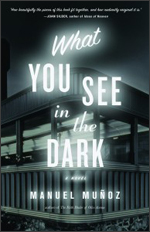
What You See in the Dark, Manuel Muñoz Algonquin Books, March 29, 2011
What we do know is this. The police had officially labeled it a homicide. Yellow tape marked the crime scene in pictures that found their way online in real time. The body of the Writer was found in a heap of blood near his desk at 8:32 A.M. Neighbors had grown suspicious upon seeing the Writer’s dog wandering the condominium hallways. The front door to the unit was ajar. The neighbor walked in and soon found the Writer on the office floor in a pool of blood just to the foot of the iMac that was still beaming brightly as if nothing at all had changed, as if it would soon be receiving input, an edit, an email, a URL typed in a browser. But things had most certainly changed. The blood streamed down, second by second, the tub being rinsed clean. It spiraled into the drain, disappearing. We also know this. The Writer had been alive at midnight CST because it was then that he phoned friend Mark Graham in Los Angeles. Graham gave police a detailed report of the ensuring conversation, explaining that nothing seemed out of the ordinary. During the call, Graham told the Writer that he had just gotten back from the gym where he had spotted the Actress who won an academy award for Best Actress for playing a serial killer. The Writer-turned-starfucker seemed very excited by this news. The phone conversation ended when the Writer told Graham that he had started an essay on the Manuel Muñoz novel What You See in the Dark, and that he wanted to write a bit more on it before calling it a night. The text of the unfinished essay is provided here, having also made it online seemingly before the body bag had even been zipped shut. * * * And then her own eyes, in a close, tight focus and a slow, painful pullback, trying not to blink. But it had been worth it, her face frozen in the stupor of cruel death, the close-up of her eye. A spiral, a circling. The slow dance in the tub repeating. Such brutality meant erasure, a cold, unblinking eye, a woman lying in a pool of her blood, which was draining away, vanishing. The bathroom in near silence, save the flow of the water, as the camera glided over to a newspaper concealing the stolen money. Psycho and The Texas Chain Saw Massacre remain the measuring sticks, the ones that made me fall in love with horror to begin with. After all this time, this is the moment you hold and remember, down to the sweaty, nervous palm of your boyfriend: the quiet in the dark of the theater, the story coming. Turning points. Life deals before and after moments. A first kiss, losing virginity, the death of a loved one. And other moments that are far less obvious but no less affecting. Painted in strained recollection in twilight years, these moments nevertheless exist as intersections also, places where things took a turn, for better, for worse. She tried to think back to the day when everything—everything, everything—had gone wrong, to the day that had led to this moment, but she couldn’t see it. She looked as hard as she could into the dark but she couldn’t see it. Remembering what it was like going to a movie theater when there was no place you would rather be, when you saw Jaws, Star Wars, Kramer vs. Kramer, Urban Cowboy, Rocky, Close Encounters of the Third Kind, 9 to 5, The Shining. An odd assortment if playing a game of common threads but there they are off the top of my head as far as remembering the experience of sitting in a darkening theater in great anticipation, looking up at the bigger than life stars with stories that could make you laugh or cry or get excited, even afraid, very afraid. The curtain rose, your eyes opened wide, and the rest of your life was about to begin. Darkness used to be the delicious moment of not knowing what would come next. You don’t see things like that anymore. Now, it seems like more of a hassle than anything else. The downtown theaters charge an arm and a leg for parking alone. Your parents or your big brother didn’t have to pay to park in a theater lot. The cost of tickets are outrageous as well and there are now even surcharges for things like silly 3-D glasses that offer up the added “pleasure” of a watching a headache manifest in multi-dimensions. The Great Gatsby in 3-D? Although you love the stadium-style seating, the theaters don’t seem as big as they used to. Hollywood’s bottom line has diluted the quality of the stories. Formulaic blockbusters—sequels and prequels, trilogies and longer series than that—hog the majority of the bigger screens bumping the indies out to the wings. You long for the days when the lights would dim minus the five TV commercials you were forced to endure before the trailers even began. So you’d rather not mess with the hassle and expense of going to a theater anymore. You picture the empty movie house in The Last Picture Show. Note to self: write about how Muñoz nails small town life, where rumor and innuendo create a reality of their own, where details have a way creating themselves, filling in the gaps of what would otherwise be impossible to ever know. * * * Certainly more than once, you will go on to explain the story of finding the dead Writer, and each time, a new detail will surface, sometimes from vague recollection, but more often than not, from conjecture or simply because it will make the story that much more vivid. And so it will become that the butcher knife that was never found shall come to be as real as the blood, as real as the axe, as real as your own breath when you saw the killer walking out the front door.
|
 |
||||||
 PRINT
PRINT
 TWITTER
 FACEBOOK
 EMAIL
EMAIL MORE
MORE